
Crafted Hardwoods and Green Star Fitouts: A Specifier's Guide
Green Star Fitouts v1 brought in something that quietly changes the maths for specifiers: every product now gets scored on how much responsibility it carries, and that score counts directly toward your rating.
The framework is called the Responsible Products Framework, and it scores each product with a Responsible Products Value (RPV) based on the third-party certifications it holds. The more verification stacked behind a material, the higher its RPV, and the more it pulls its weight toward Credit Achievement and Exceptional Performance.
This is where Crafted Hardwoods does some heavy lifting.
Chain of Custody certified to FSC® and PEFC standards
Red List Approved under the Declare Label
Verified Product Carbon Footprint for our Blackbutt species
All three certifications are recognised under GBCA's Responsible Products Framework, which gives our material a strong RPV that project teams can apply across the three Responsible Products credits where our material is relevant:
Credit 11 (Finishes & Joinery),
Credit 12 (Responsible Partitions) and
Credit 13 (Responsible Furniture).
But RPV is only part of the picture. Our timber also supports Credit 18 (Low Toxin Materials), and Credit 27 (Upfront Carbon Reduction) through material substitution against higher-carbon alternatives.
Each credit uses a different mechanism, and this page walks through exactly where we fit and what your team needs.
Our RPV Score
The RPV isn’t a points tally. It’s a threshold: products need to reach a minimum RPV to qualify, and credit achievement depends on what proportion of your fitout (by cost) meets that bar.
Green Star recognises products at two performance tiers:
RPV ≥ 7 for Good Practice
RPV ≥ 12 for Best Practice
Across our species, our RPV score sits between 17 and 20, well above the Best Practice threshold. (Blackbutt sits at 20 thanks to its third-party verified PCF)
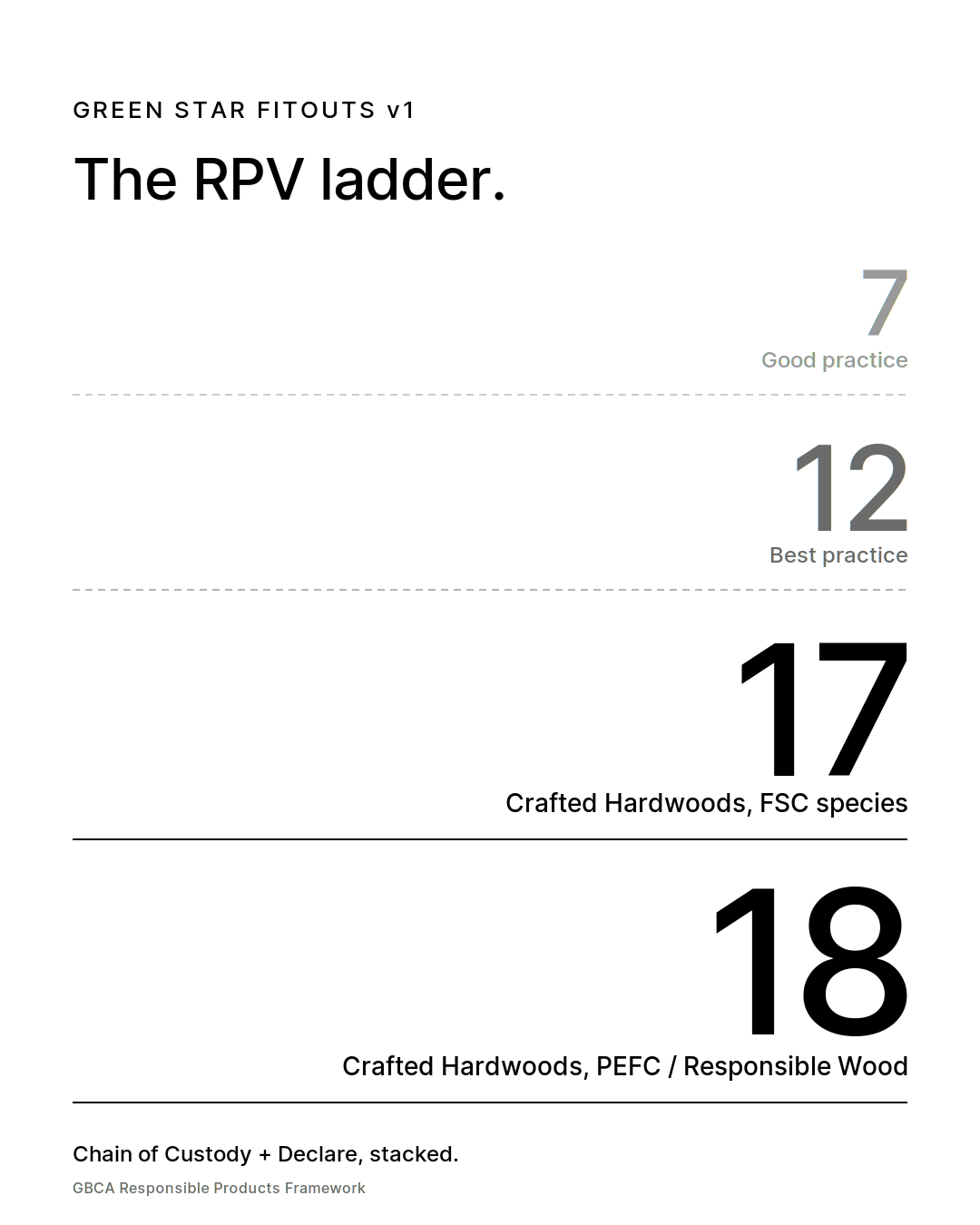
A little Best Practice can go a long way.
Across the Responsible Products credits, projects can pursue either the Good or Best Practice pathway. But Best Practice products do the heavy lifting: a smaller share of the fitout (by cost) reaches the same point ceiling that a much larger share of Good Practice products would.
Here's what that looks like in practice. In Credit 11, the Good Practice route to maximum Exceptional Performance requires 80% of the fitout by cost. The Best Practice route requires 20%. That four-to-one efficiency is where Crafted Hardwoods becomes a strategic specification: a single design element in our timber, like joinery or wall lining can unlock Exceptional Performance points that would otherwise take a fitout-wide commitment to lower-RPV products.
Unlocking Responsible Products credits
Timber is one of the few materials that moves naturally across three of the four Responsible Products credit categories:
Credit 11 — Responsible Finishes & Joinery
Credit 12 — Responsible Partitions
Credit 13 — Responsible Furniture
Specified across all three relevant Responsible Products credits, our material can contribute up to 10 points toward your rating. The table below breaks down where the points sit, the common applications for our material in each credit, and the percentage by cost needed to unlock each level.
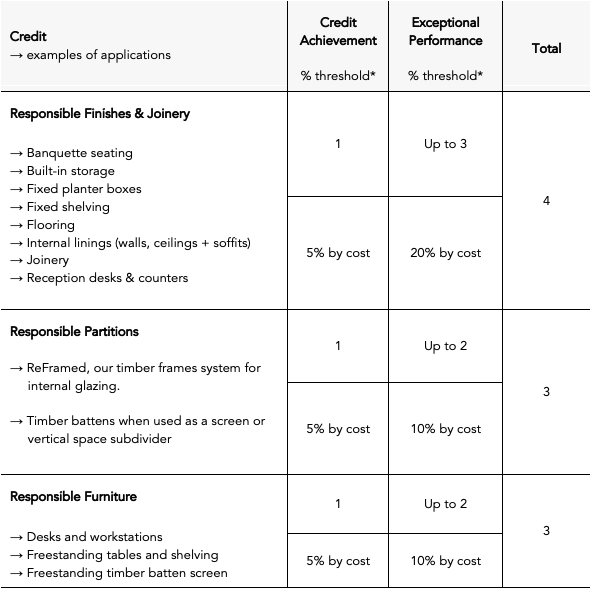
What your team needs: Evidence of our RPV (via the GBCA Responsible Products Score Checker), proof of purchase and a bill of quantities showing the proportion of our material by cost. Please note that Chain of Custody certified supply must be requested at the time of ordering. This ensures the correct claim appears on your invoice.
Credit 18 - Low Toxin Materials
Credit 18 sits in the Healthy category and limits occupant exposure to toxins. It operates independently from the RPV and uses a different compliance mechanism.
This is where it gets important: Low Toxin Materials Procurement isn't a points-earning criterion. It's a Minimum Expectation, which means every project pursuing any Green Star Fitouts rating must demonstrate compliance with it.
Project teams can use our Declare Label as a direct pathway to demonstrating Low Toxin Materials Procurement compliance for our material. All species are covered under the one label.
What your team needs: A copy of our current Declare Label, proof of purchase, and a finishes schedule that includes our product.
Credit 27 - Upfront Carbon Reduction
Credit 27 rewards projects that reduce upfront carbon emissions compared to a reference fitout. The mechanism here is a comparative calculation, not a product certification.
Where Crafted Hardwoods supports this credit is through material substitution. Timber is inherently lower in embodied carbon than many conventional fitout materials. Where a project team replaces aluminium, steel, or high-carbon alternatives with our timber, the delta contributes to their Credit 27 reduction.
The carbon case for ReFramed
Partitions are a quiet carbon problem in most fitouts. They're usually aluminium-framed, and aluminium is heavy on carbon. You don't notice it on any single partition, but multiply that across a fitout and it stacks up fast.
ReFramed is our timber framing system, built to work the same way aluminium does, but with a fraction of the embodies carbon. If glazing partitions are in scope for your project, take a look at our dedicated ReFramed + Credit 27 page. It walks through how the calculation comes together and what each side of the equation needs.
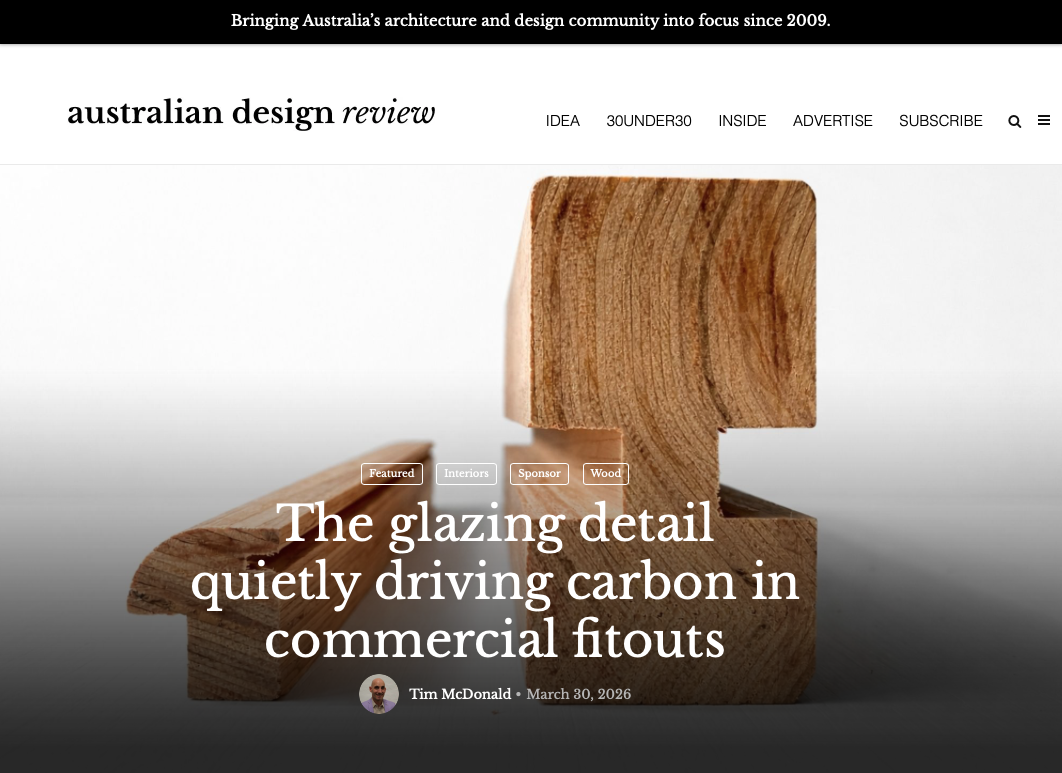
We sat with Australian Design Review to share the story behind ReFramed.
Conclusion
Across Credits 11, 12, 13, 18 and 27, our material does real work for project teams chasing Green Star points. Best Practice RPV across all our species, Declare Label compliance for Low Toxin Materials, and a verified PCF for one of our flagship species to support Credit 27 calculations.
That's five credits and up to 10 points where the paperwork is already sitting in a folder, not something you have to chase down mid-project. If you've got a Green Star Fitouts submission on the boards, let's talk about where we fit.