
FSC® certified timber in Australia: yes, it exists. We make it.
Our Darren was at a Breathe Architecture’s event when a panelist said (with genuine frustration) that he couldn't source FSC-certified timber in Australia for a project.
Darren nearly left his seat.
He didn't say anything, because you don't interrupt a panel. That's rude. But the whole time he was sitting there thinking: we literally make that. FSC-certified, Australian-manufactured, engineered hardwood. It's what we do. And this person, someone specifying timber for a real project, had no idea we existed.
Darren should never have to sit on his hands again. So let's answer the question directly.
Yes, you can source FSC-certified hardwood in Australia. Crafted Hardwoods holds FSC Chain of Custody certification and can supply FSC-certified timber for your project.
If you're an architect, designer, builder, or specifier looking for:
FSC-certified hardwood for a commercial or residential project
PEFC-certified hardwood with a verified chain of custody
Australian-made timber that qualifies under Green Star’s Responsible Products Framework
FSC certified and Red List approved timber for a Living Building Challenge project
...this is us, putting our hand up.
Why is FSC so rare for Australian-grown timber?
If you've been struggling to find it, you're not imagining things. FSC certified timber accounts for just 6% of Australia's certified forest area, and most of that is plantation softwood, not hardwood species typically specified for architectural applications. Why so little FSC in Australian timber? We've been asking ourselves the same thing, because we are not exempt from the problem. Rotary peeled veneer to our specification isn't currently available with FSC certification in Australia, which means we need to source our FSC-certified raw material from overseas.
Our understanding is that Australia developed its own rigorous national certification scheme (now called Responsible Wood, endorsed by PEFC) before FSC became the global default. It was built from the ground up within Australia's own legislative and ecological settings, accredited by Standards Australia, and designed to be locally fit-for-purpose. FSC, by contrast, applies a globally centralised model where international standards are adapted to national conditions, a process that has proven more straightforward in some countries than in Australia's complex native forestry context.
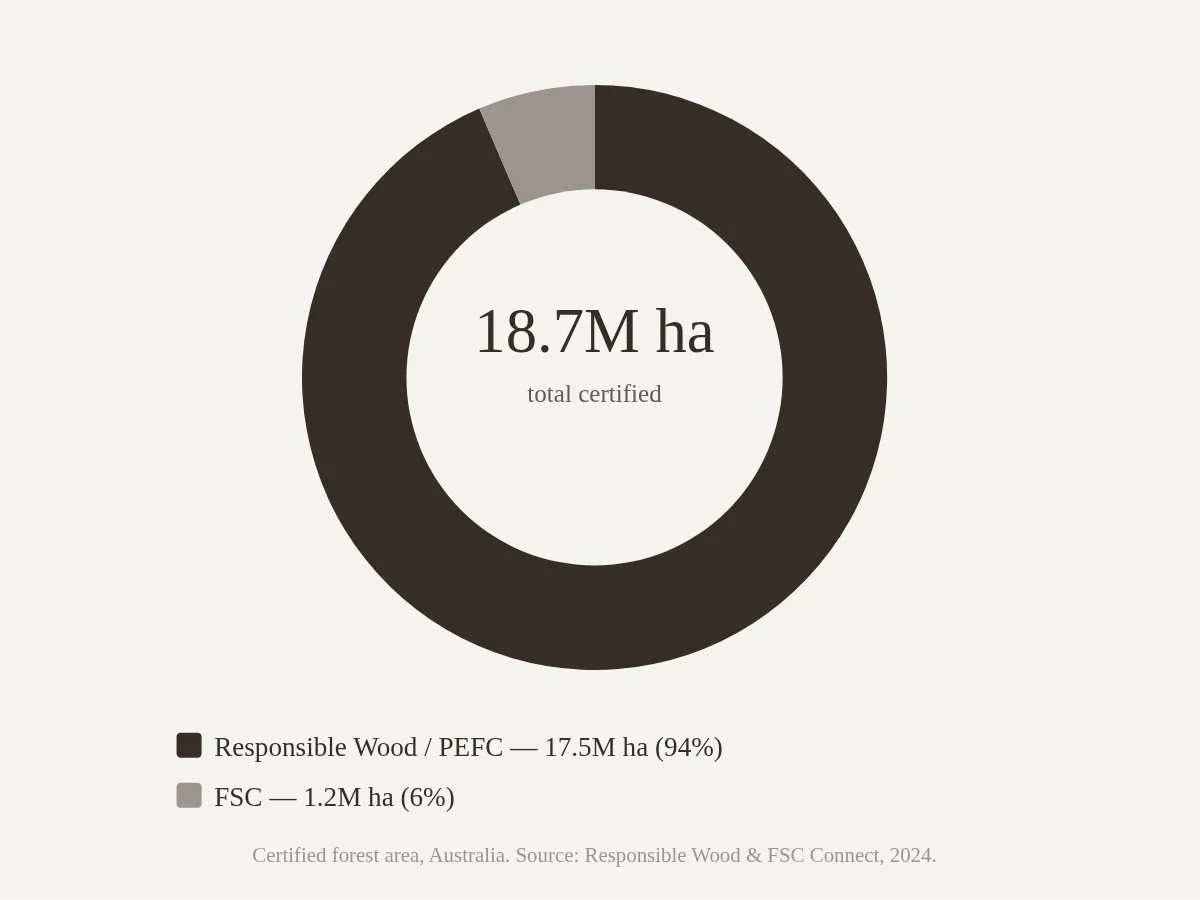
The result is that most Australian timber certifies under Responsible Wood/PEFC rather than FSC — not because it's less sustainable, but because of how the two systems evolved in parallel. The GBCA's Responsible Products Framework recognises both schemes as Best Practice materials: FSC certified timber scores 13 RPV and Responsible Wood scores 12, both clearing the Best Practice threshold in Green Star projects.
There is one context where the FSC vs PEFC distinction genuinely matters: the Living Building Challenge. Unlike Green Star, LBC 4.1 calls for FSC-certified timber specifically. For projects pursuing Living or Petal Certification, Imperative 14 requires that 80% of all wood by cost or volume is FSC certified, salvaged, or harvested on-site, with the remaining 20% permitted from low-risk sources, which includes PEFC/Responsible Wood certified timber.
Why does LBC name FSC specifically? It's not arbitrary. PEFC is an umbrella body that endorses national schemes, and the rigour of those schemes genuinely varies by country. In parts of the world where forest regulation is weak or poorly enforced, FSC does set a meaningfully higher bar. LBC is a global standard, and it can't make country-by-country distinctions. So specifying FSC by name is a defensible position for a tool designed to work across very different contexts. Whether that logic holds in Australia is a separate question.
Is FSC really more rigorous than Responsible Wood?
This is the question sitting underneath all of this, and we think it deserves a straight answer, at least in the Australian context.
We're not going to claim that PEFC equals FSC everywhere in the world, that would be overstating it. But in Australia, the case for equivalence is genuinely strong.
Responsible Wood is built on two Australian Standards: AS 4708 for forest management and AS 4707 for chain of custody. Both developed through a rigorous, independently audited, nationally specific process. A 2025 independent review commissioned by Forest and Wood Products Australia compared the two schemes in detail, mapping Responsible Wood's requirements against all 70 of FSC's criteria. It found 64 of 70 broadly comparable, with no criteria rated as having low comparability.
Australia also has some of the world's strictest illegal logging laws, with the Illegal Logging Prohibition Act 2012 applying due diligence requirements to both domestic processors and importers. The regulatory baseline here is already high.
So when a specifier in Australia reaches for FSC on instinct, assuming it's the more rigorous choice, they may be working from a global reputation that doesn't fully account for what's already in place here.
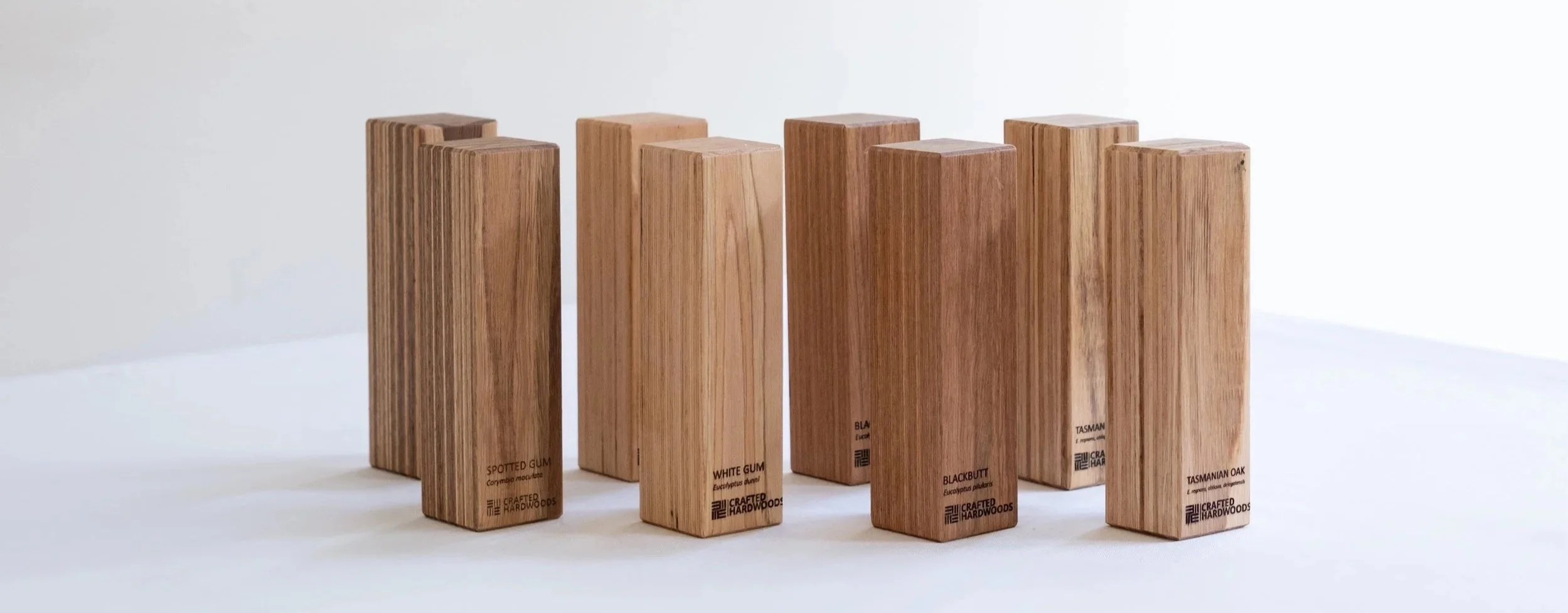
A selection of Crafted Hardwoods species. All certified, all architectural grade.
A bit more about what we make
Crafted Hardwoods engineers hardwood from timber that's typically bypassed in conventional supply chains. Most of it would otherwise be chipped, exported as low-value raw material, or burnt for energy. We turn it into architectural-grade hardwood instead, which is, when you think about it, about as circular as timber gets.
Our timber is suited to a wide range of architectural applications: linings, cladding, soffits, battens, posts, beams, internal glazing frames, joinery, staircases, handrails, dowels, and more, across both commercial and residential projects. We're based in Adelaide, South Australia, and supply Australia-wide.
We hold FSC Chain of Custody certification (C209115), Responsible Wood/PEFC certification (PEFC/21-31-397), and all our species are covered under our Declare Label. We can provide full documentation to support Green Star projects, Living Building Challenge requirements, and responsible procurement policies.