ReFramed & upfront carbon reduction in Green Star Fitouts
If embodied carbon is on the brief, ReFramed has a clear case to make. This page walks through how it compares to aluminium baselines, and what your LCA practitioner needs if you're working toward Green Star Fitouts Credit 27.
Context
Credit 27 under Green Star Fitouts v1 rewards projects whose fitout delivers lower upfront embodied carbon than a reference fitout. Reductions are calculated via the GBCA Upfront Carbon and Circularity Calculator or a comparative LCA.
Internal partitions sit within Credit 27's scope, and the scale is what makes them worth looking at closely: a single corridor of meeting rooms can run to hundreds of lineal metres, and ReFramed's carbon advantage stacks up on every one of them.
What the numbers show
Timber's advantage over aluminium in embodied carbon isn't subtle. Aluminium smelting is one of the most energy-intensive manufacturing processes there is. Getting timber from log to finished profile uses a fraction of that carbon. For a Credit 27 submission, that's exactly the kind of difference worth looking at.
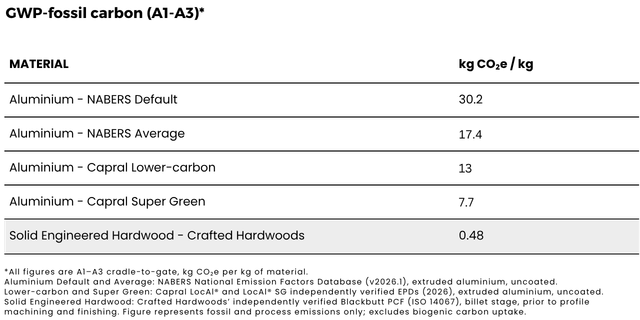
To give you a sense of the carbon savings the switch from aluminium to timber glazed partition can make, we've compared our Blackbutt’s A1-A3 fossil footprint to four different aluminium baselines: NABERS default, NABERS average and Capral recently published EPDs for their lower-carbon aluminium. Together, these cover the range of aluminium a project is likely to encounter, from the conservative default through to the lowest-carbon option available.
Bear in mind: this is a material-level comparison. It's here to give a sense of scale, not to predict a project outcome. The actual saving will depend on your specific framing and which aluminium system ReFramed is replacing.
Our Blackbutt's carbon factor comes in 94% to 98% lower in fossil carbon compared to four aluminium baselines, from the lowest-carbon verified product on the market through to the NABERS default.
Default, average or verified: which number counts?
You'll notice the table includes several aluminium figures: default, average, lower-carbon, and Super Green. It's worth knowing where each one belongs, because a certified rating won't use them interchangeably.
The default and average come from the NABERS National Emission Factors Database. NABERS is free, publicly accessible, and published by an Australian government program. It's becoming the standard reference for embodied carbon calculations in Australia, which makes it the most defensible starting point for a comparison like this. Lower-carbon and Super Green values come from Capral's independently verified LocAl® and LocAl® SG EPDs. Our material’s carbon intensity of 0.48kgCO2e/kg is derived from our Blackbutt PCF, normalised to mass using the timber’s density of 950kg/m3. All figures sit at the same stage, A1–A3 cradle-to-gate.
So what number goes into an actual submission? One of three things: a verified product-specific figure, either a PCF or an EPD, where one exists; the NABERS default, where it doesn't; or a factor from another recognised database your LCA practitioner is using, such as AusLCI through eTool.
In a NABERS-based submission, the default applies automatically whenever a project doesn't have a product-specific EPD for the material in question. There's no in-between: no EPD means the default is used, full stop.
The NABERS published average sits outside that system. It's a useful reference for an indicative comparison like this one, showing what aluminium framing typically costs in carbon terms, but it isn't a number a certified rating would apply.
How your LCA practitioner uses this data
To turn carbon factors into a partition-level comparison, your practitioner combines it with two project-specific inputs: how much framing the design uses and how much that framing weighs.
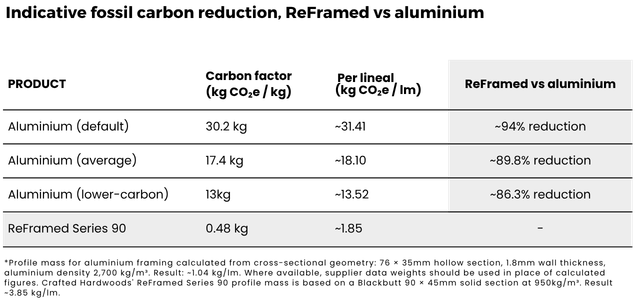
The table below compares ReFramed Series 90 with a representative 76 × 35mm aluminium profile, and shows the reduction across across various carbon factors (default, average, lower-carbon). The actual saving for your specific project depends on what ReFramed is replacing. Aluminium partition profiles vary in size and wall thickness, so the mass per lineal metre changes from system to system. Even against slimmer, lighter-weight profiles, the gap in carbon factor is wide enough that a saving is still there to be made.
How a Credit 27 submission comes together
ReFramed won't single-handedly deliver a Credit 27 point. The credit rewards projects whose proposed fitout has measurably lower upfront carbon than a reference fitout, calculated across all materials. Within that calculation, some specification changes move the needle harder than others. ReFramed is one of them.
What Crafted Hardwoods provides
A1–A3 Product Carbon Footprint data (ISO 14067)
Product specifications and weight per lineal metre for the relevant ReFramed profile series
What the project team calculates
Total mass of framing for both the reference aluminium system and the proposed ReFramed system, based on lineal metres and profile dimensions.
Full A1–A5 fitout carbon comparison including A4 (transport to site) and A5 (installation), using project-specific data.
Reference vs proposed fitout comparison via the GBCA Upfront Carbon & Circularity Calculator or a comparative LCA, with aluminium reference inputs drawn from NABERS or other recognised datasets.
What Credit 27 doesn't see
One further point worth naming: the biogenic carbon stored in the timber itself sits outside the fossil A1–A3 scope this comparison uses, and outside the figures typically used for an upfront carbon reduction target. It's a separate conversation, but a real one. Every lineal metre of ReFramed holds atmospheric carbon out of circulation for the life of the partition. It's a benefit only a grown material can offer.
Ready to spec?
If you're targeting Credit 27 and considering ReFramed, send through your floor plan or partition schedule. We'll come back with a carbon comparison based on your actual framing run and our verified PCF, so you can see the impact before you commit to the specification.