
The default you've stopped noticing
Every fitout makes a thousand material decisions. The frame around glazed partitions rarely makes the list.
Aluminium with slim, powder-coated sightlines, repeated across floorplates and projects for decades. The category has held its shape so long the choice barely registers as one. First it became standard, then it stopped being a decision at all.
Until you start asking a simple question: what's the carbon footprint of the frame itself?
We tried to answer that. Not in a theoretical way, just a straightforward comparison. Take a typical internal aluminium glazed partition, quantify the embodied carbon, and compare it with timber. The kind of exercise that should be routine by now.
But when it comes to internal aluminium partition systems, the data isn't easy to find. Not at the level where decisions are actually made. There's good information on aluminium as a material. There are detailed studies on façades and window systems. But internal glazing frames, the systems used across almost every commercial fitout, tend to sit outside that level of scrutiny.
So we had a crack at it ourselves, using verified data where we could and being upfront about the assumptions where we couldn't. What we found was more significant than we expected.
Let’s run the numbers
Start at the material level. Strip both options back to the raw billet, before anything's extruded or machined, and measure the embodied carbon per kilogram (A1–A3, cradle-to-gate). This is the fairest place to begin, because it compares the materials themselves, not the shapes we make from them.
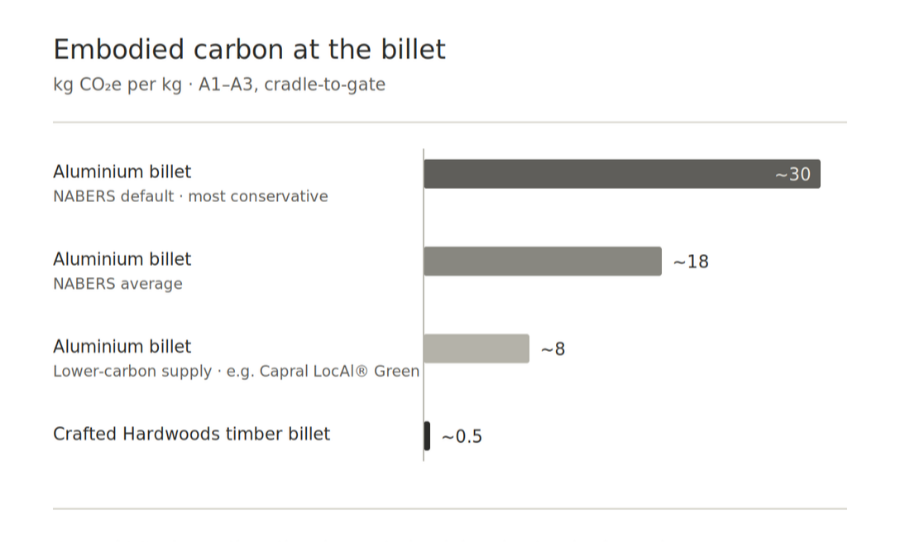
Per kilogram, our timber sits around thirty-six times below the NABERS average, the figure most projects would reference, and up to sixty times below the NABERS default, the most conservative benchmark in use. Even against Capral LocAl® Green, one of the lowest-carbon aluminiums available as standard in Australia, it's still roughly sixteen times lower. Pick any benchmark you like, the order of magnitude holds.
Per kilogram isn't the whole story though, and we wouldn't want anyone reading this to think we'd stopped there. Aluminium is extruded hollow, so it uses less material per metre of frame. Timber profiles are solid, so they use more. Any honest comparison has to account for it.
So we did. Profile against profile, a Series 90 timber frame against an aluminium section built to do the same job, a 76 × 35mm hollow extrusion at around 1 kg per lineal metre, ReFramed carries 78% to 90% less embodied carbon per lineal metre. The range moves depending on which aluminium baseline you compare against, but the bottom of that range, 78%, is the figure you get against the lowest-carbon aluminium available as standard in Australia. The comparison only gets better from there.
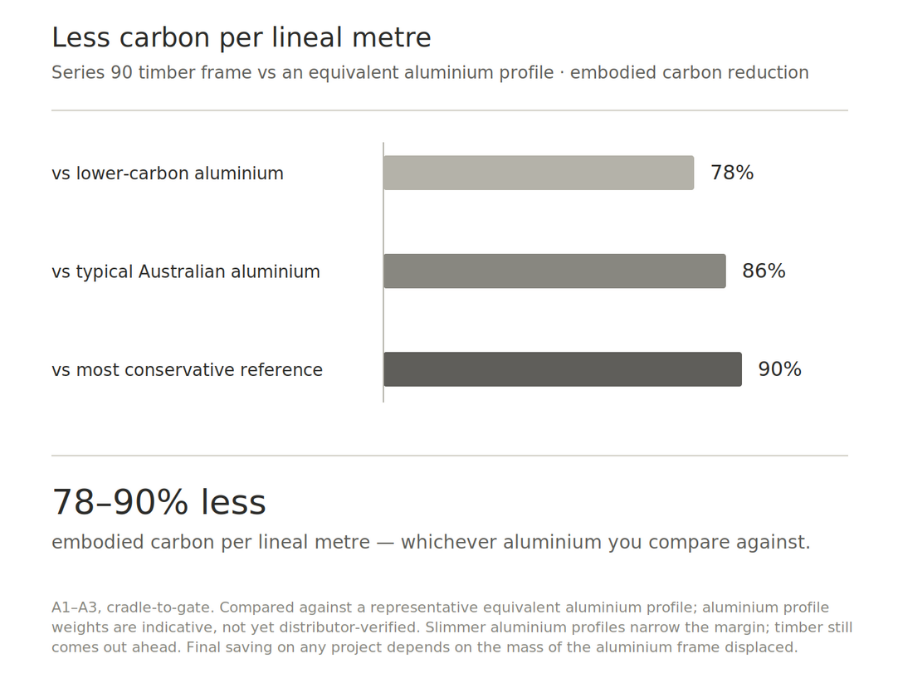
The exact saving on your project will track the mass of the aluminium frame ReFramed replaces, which is a project-by-project number. We've used a standard, representative profile here so the comparison is like-for-like. You'll find slimmer aluminium profiles out there, lighter sections that narrow the margin. Timber still wins, just by a little less.
The real reason aluminium became the default
The carbon case is clear enough. But it doesn't explain why aluminium became the default in the first place, and that's the part worth understanding.
Because the dominance of aluminium in internal glazing isn't really about the material. It's about the system.
Aluminium didn't win because people love it. It won because it enabled a way of building that made sense: modular components, repeatable junctions, fast installation, predictable outcomes. It reduced risk. It standardised a complex process. That's what the industry adopted, not aluminium for its own sake, but the reliability of the system it supports.
So any alternative has to meet that same expectation.
The question isn't whether another material can replace aluminium in isolation. It's whether it can operate within the same system logic, the same rhythms of design, documentation, and construction.
If a material like engineered timber can be produced in consistent sections, integrated into standard partition layouts, and installed using familiar methods, then the barrier to change becomes much smaller. It's no longer a redesign of the system. It's a shift in what that system is made from.
Carbon isn't the only difference
This one’s harder to quantify but just as visible.
Most office interiors share a common visual language. Aluminium and glass make spaces that are precise and efficient, and often interchangeable. Timber brings something the others don't: variation, texture, a sense that the material has origin and depth. And it does this without disrupting the system underneath. The geometry stays disciplined, the detailing stays clean. What changes is how the space feels to be in.
Which brings the conversation back to where it started.
Internal glazing isn't going anywhere. It's too useful, too embedded, too effective as a spatial tool. But the material that defines it has largely gone unquestioned. As embodied carbon becomes a more immediate constraint on design, those defaults start to matter more. Not just in large, structural elements, but in the repeatable systems that make up the majority of a fitout.
Aluminium partitions solved a problem. Now we have the opportunity to solve the next one.
ReFramed is our attempt to do exactly that.
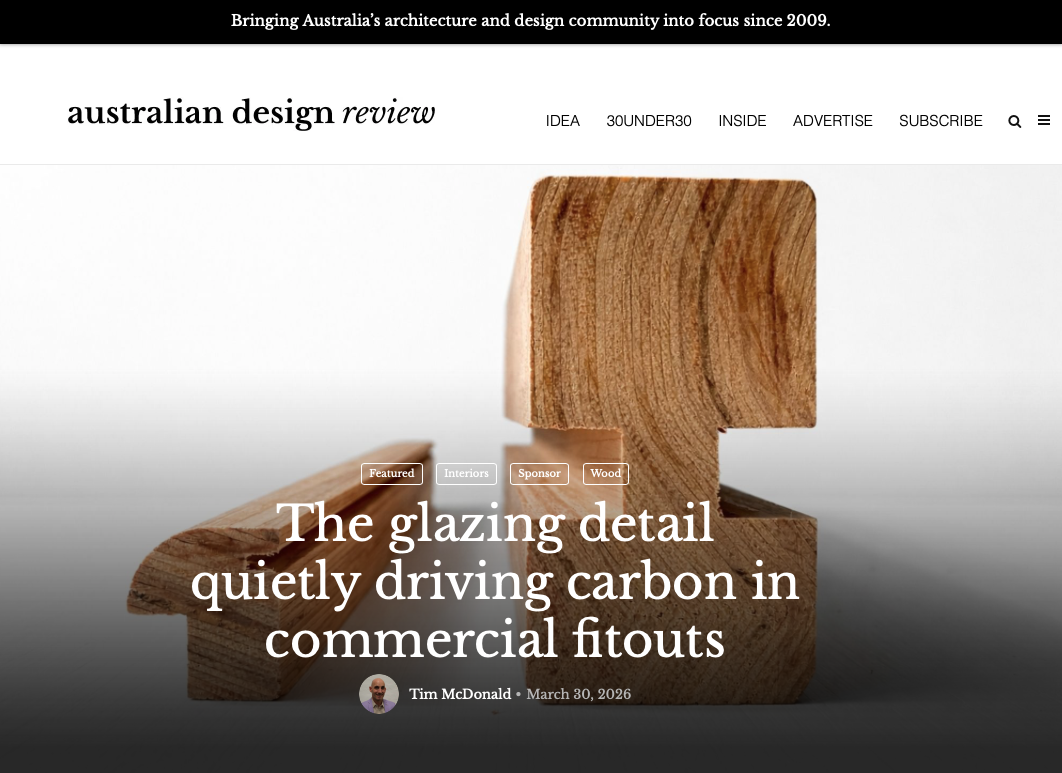
We shared the journey with Australian Design Review. Click the image to read the story.
ReFramed: a timber alternative, built for the way fitouts already work
ReFramed is our take on a modular timber glazing system for commercial interiors. It comes from spending a lot of time looking at what works about aluminium, and asking whether the material itself could be reconsidered without losing that logic.
We’d love to get ReFramed in front of you.
The default isn't going to change itself. If you're ready to question it on a project, we're ready to help. If you haven’t already, hit the ReFramed page to download the brochure, access the CAD + Revit files or see how the switch can support your Green Star submission.
Already in? Send through a floor plan or a spec, and we'll come back with what's possible.
Geoff, Darren & Cristel
The Crafted Team